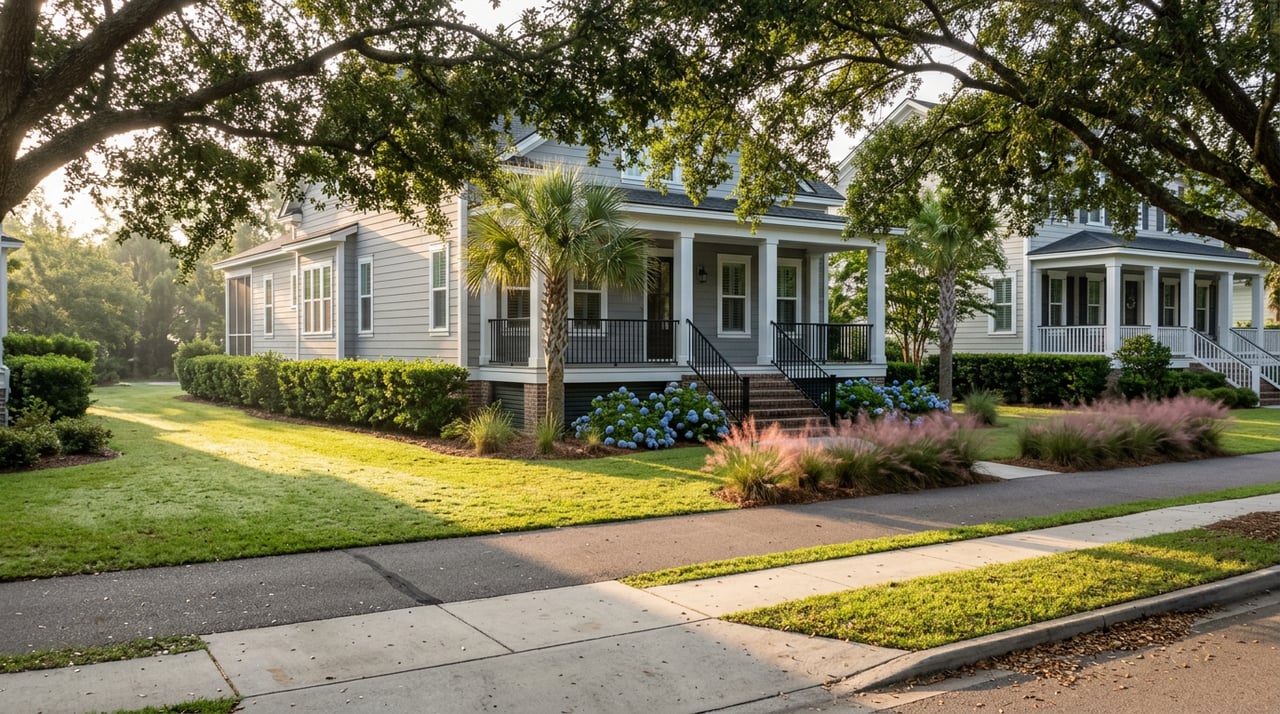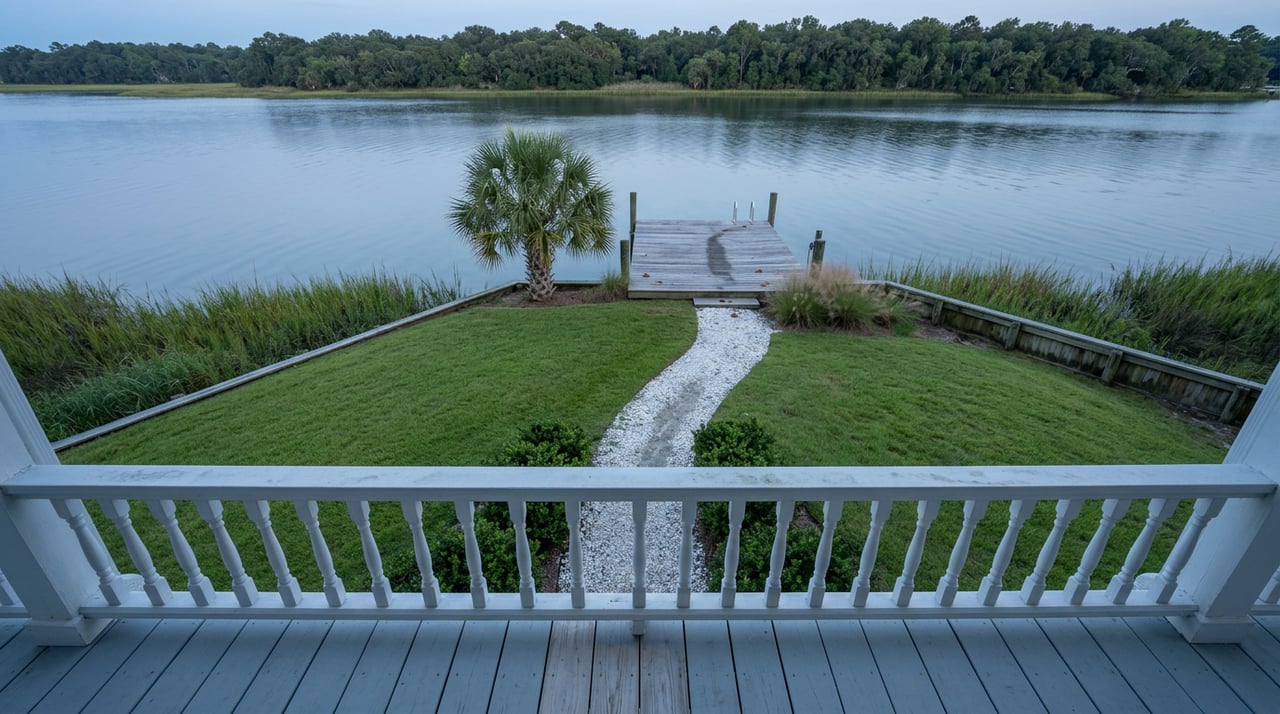
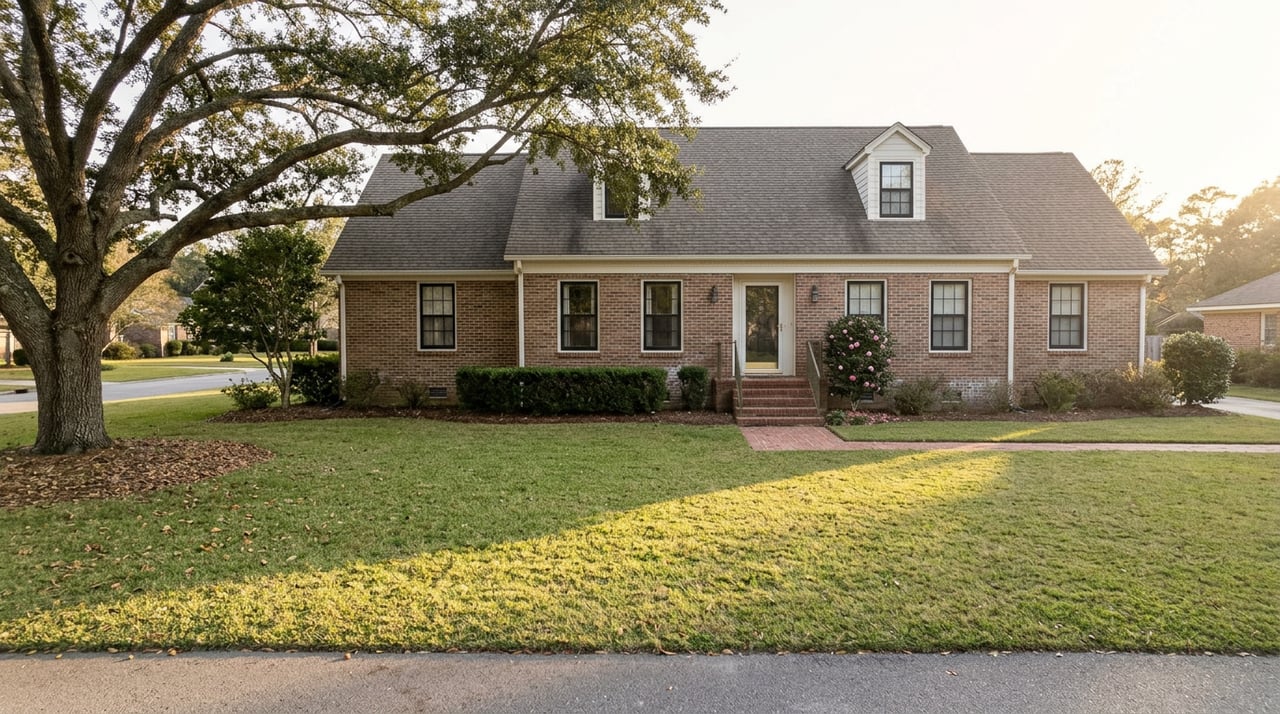
Pull up three Mount Pleasant HOA disclosures side by side and Snee Farm looks like the deal of the neighborhood-comparison table. Carolina Park runs close to $1,300 a year. Dunes West splits its residents into two tiers, with the gated side paying around $2,020 a year and the ungated side closer to $522. Then there's Snee Farm's Community Foundation assessment: $415, due every February 28.
If you're cross-shopping these communities for a move to Mount Pleasant, that number does something to your brain. It reads like Snee Farm is the value play, the older neighborhood where you get the mature oaks and the central location without paying for someone else's clubhouse. That read is wrong in a way that matters at the closing table. The fee isn't smaller because living in Snee Farm costs less. It's smaller because the fee is answering a narrower question than you think it is, and the parts it leaves out are exactly the parts that show up later as a bill.
What $415 Actually Pays For
The Snee Farm Community Foundation assessment covers common-area upkeep, entry landscaping, and covenant enforcement for the neighborhood's Architectural Control Committee. It does not fund a pool, a golf course, or a clubhouse, because none of those things belong to the HOA.
It also doesn't apply evenly across everyone who tells you they live in Snee Farm. The $415 figure covers the roughly 891 homes inside the SFCF master umbrella: Snee Farm proper, New Charlestowne, and Snee Farm Gardens. Snee Farm Lakes runs on its own separate regime fee, in the neighborhood of $378 to $495 a month depending on the unit. Ventura Villas carries its own separate fee too. Snee Farm Village pays a $510 quarterly sub-HOA, and whether a given Village parcel also owes the SFCF master assessment on top of that varies by lot, which is exactly the kind of layering worth confirming in the resale package before you assume you know the number. All of these sit inside the same branded neighborhood of roughly 1,329 homes, and a buyer comparing two listings with "Snee Farm" in the subdivision field can be looking at entirely different fee schedules without realizing it. That's worth a direct question to your agent before you assume the $415 figure applies to a specific address.
The Club Is a Separate Company
Here's the part that trips up buyers moving from newer master-planned communities where amenities are just bundled into the dues. In Carolina Park, the higher HOA fee funds a resort-style pool that every homeowner pays into, whether they swim or not. In Snee Farm, the golf course, tennis complex, and clubhouse belong to Snee Farm Country Club, a private business run separately from the Community Foundation that collects your $415. Membership does not convey with the home. You apply for it, and you pay for it, on top of whatever else you're already budgeting.
The club is affiliated with the ClubCorp network, which opens the door to more than 200 private clubs, and it offers dual and triple membership options that add access to RiverTowne Country Club and Dunes West Golf Club for residents who want more than one course. Third-party club-fee trackers put initiation somewhere between roughly $2,500 and $10,000 depending on membership tier, with annual dues ranging from nothing for a basic social tier up to around $5,000 for full golf access. Those numbers move, and the club's own membership office is the only source worth trusting for a current rate sheet before you factor it into an offer. The point isn't the exact figure. It's that the fairway view outside a Snee Farm listing photo is not included in the sale, and pricing it into your first year of ownership belongs in the same conversation as the HOA disclosure, not an afterthought after closing.
The Real Bill Is in the Walls, Not the Disclosure
Snee Farm went up fast by neighborhood standards. Recorded plats run from 1971 through Snee Farm Gardens in 1981, with the bulk of construction wrapped up by the late 1980s. That means most of the housing stock is now somewhere between 38 and 55 years old, and it all got its original roof, HVAC system, electrical panel, and plumbing in roughly the same narrow window. Systems don't fail on a schedule, but when an entire neighborhood's infrastructure was installed within fifteen years of itself, the replacements tend to cluster too.
You can see this show up in how current sellers are marketing their homes. Recent listings lead with lines like "new roof 2024, new water heater, new HVAC 2023, new ductwork 2025, crawlspace encapsulated 2025" as the headline selling point, ahead of square footage or finishes. One recently marketed property went further and described a full down-to-the-studs renovation, replacing floor joists and subflooring along with the roof, windows, and HVAC, framed explicitly as removing "the contractor timelines and the renovation guesswork" for the next buyer. Sellers are pricing this in because buyers are asking about it. None of that carrying cost appears on an HOA disclosure. It shows up at inspection, and it's the actual difference between a Snee Farm home that's move-in ready and one that needs six figures of deferred maintenance behind a great location.
Before writing an offer in Snee Farm, it's worth confirming a short list of things that don't show up in the listing photos:
- Which fee structure applies to the specific address: SFCF's $415 annual assessment, the Lakes regime fee, or the Village quarterly fee
- Documented age of the roof, HVAC system, electrical panel, and plumbing, given that original systems date to the 1971-to-late-1980s build window
- Whether the home's construction date puts it under federal pre-1978 lead paint disclosure requirements
- Whether planned exterior work, a fence, an addition, a pool, or tree removal above a certain trunk diameter, needs Architectural Control Committee approval before permits are pulled
- The country club's current initiation and dues rate sheet if golf, tennis, or pool access factors into your decision
Why the Median Price Depends on Which Snee Farm You're Looking At
Pull market data on Snee Farm from different trackers in 2026 and you'll get numbers that don't agree with each other. One April snapshot showed a median listing price of $718,000 against a median sold price near $850,000. A three-month window through May put the sold median at $849,714, or $439 per square foot. A June snapshot showed a list median closer to $734,000, down about 8 percent from both the prior month and the prior year. Another tracker put the sold median near $800,000.
That spread isn't a data quality problem. It's the same mechanism showing up in the price. An updated ranch in Snee Farm Gardens with a documented new roof and HVAC is a fundamentally different product than a 1976 golf-course estate that's never been touched, even if both carry the same subdivision name. A townhome in Ventura Villas paying a monthly regime fee competes in a different price band than a half-acre lot backing the seventh fairway. The median isn't wrong. It's averaging across homes that don't behave like a single market, which is exactly why the number on a portal search means less here than it would in a neighborhood built in a single five-year phase with one uniform HOA.
What This Means If You're Comparing Snee Farm to Something Newer
If you're cross-shopping Snee Farm against Carolina Park, Park West, or Dunes West, the honest comparison isn't $415 against $1,300. It's what each fee actually funds, and what the other bill looks like once you factor in club membership and system age. A newer community's higher HOA often buys you amenities included and systems under warranty. Snee Farm's lower HOA buys you mature trees, a central address, and a golf course you can look at without owning access to it, plus a housing stock where the next big expense is a real possibility rather than a hypothetical.
Neither is the wrong answer. But only one of them is captured accurately by the number most portals put in bold at the top of the listing.
If you're weighing Snee Farm against other Mount Pleasant neighborhoods and want help pricing out what a specific address actually costs to own, not just to buy, Living Charleston Realty can walk the numbers with you before you write an offer. Get Your Instant Home Valuation to see where your comparison should start.
FAQ
Does buying a home in Snee Farm include country club membership? No. Snee Farm Country Club is a private business separate from the neighborhood's HOA, and golf, tennis, and pool access require a separate membership application and fee that does not transfer with the sale.
Can I rent my Snee Farm home short-term? No. SFCF covenants prohibit short-term rentals, which makes Snee Farm properties ineligible for a Town of Mount Pleasant short-term rental permit under the town's current code.
Do all of Snee Farm's sub-communities pay the same HOA fee? No. Snee Farm proper, New Charlestowne, and Snee Farm Gardens fall under the SFCF's $415 annual assessment. Snee Farm Lakes and Ventura Villas each pay their own separate regime fees, and Snee Farm Village pays a $510 quarterly sub-HOA, with layering onto the SFCF master varying by parcel.